Prethermalization by random multipolar driving on a 78-qubit processor
2026-01-30 11:14
619 浏览
Time-dependent drives hold promise for realizing non-equilibrium many-body phenomena that are absent in undriven
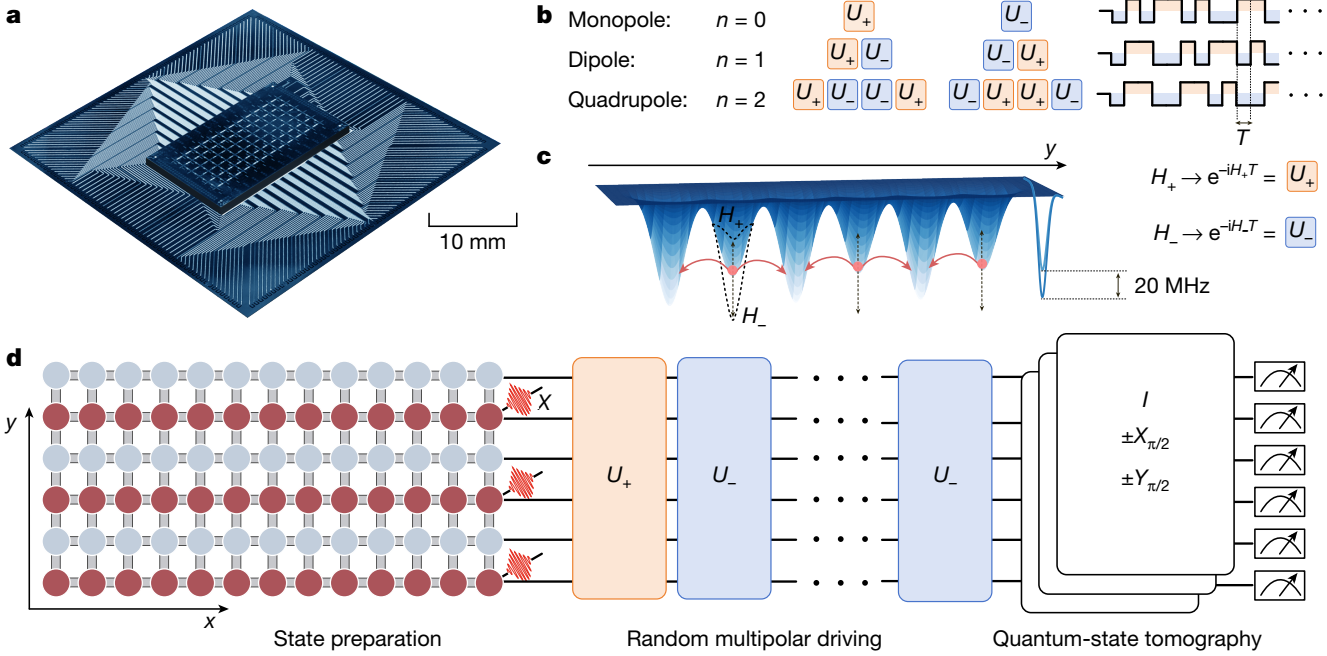
systems1,2,3. Yet, drive-induced heating normally destabilizes the systems4,5, which can be parametrically suppressed in
the high-frequency regime by using periodic (Floquet) drives6,7. It remains largely unknown to what extent highly
controllable quantum simulators can suppress heating in non-periodically driven systems. Here, using the 78-qubit
superconducting quantum processor, Chuang-tzu 2.0, we report the experimental observation of long-lived prethermal
phases in many-body systems with tunable heating rates, driven by structured random protocols, characterized by
n-multipolar temporal correlations. By measuring both the particle imbalance and subsystem entanglement entropy,
we monitor the entire heating process over 1,000 driving cycles and observe the existence of the prethermal plateau. The
prethermal lifetime is ‘doubly tunable’: one way by driving frequency, the other way by multipolar order; it grows
algebraically with the frequency with the universal scaling exponent 2n + 1. Using quantum-state tomography on different
subsystems, we demonstrate a non-uniform spatial entanglement distribution and observe a crossover from area-law to
volume-law entanglement scaling. With 78 qubits and 137 couplers in a two-dimensional configuration, the entire far-from
-equilibrium heating dynamics are beyond the reach of simulation using tensor-network numerical techniques. Our work
highlights superconducting quantum processors as a powerful platform for exploring universal scaling laws and non-
equilibrium phases of matter in driven systems in regimes where classical simulation faces formidable challenges.
Link to the article is here.
